In the vast, blocky universe of Minecraft, where creativity seems to have no bounds, players often encounter surprising limitations within the game's intricate simulation. One such poignant limitation was recently highlighted by the community, centering on one of the game's most beloved neutral mobs: the dolphin. A player, sharing a heartrending scene on a popular forum, asked a question that resonates with many animal-loving builders: why can't these intelligent, graceful creatures survive in a carefully constructed, beautiful aquarium? The answer, while rooted in the game's mechanics, opens a fascinating discussion about realism, mob behavior, and the ongoing evolution of this classic title, which continues to thrive with immense popularity in 2026.
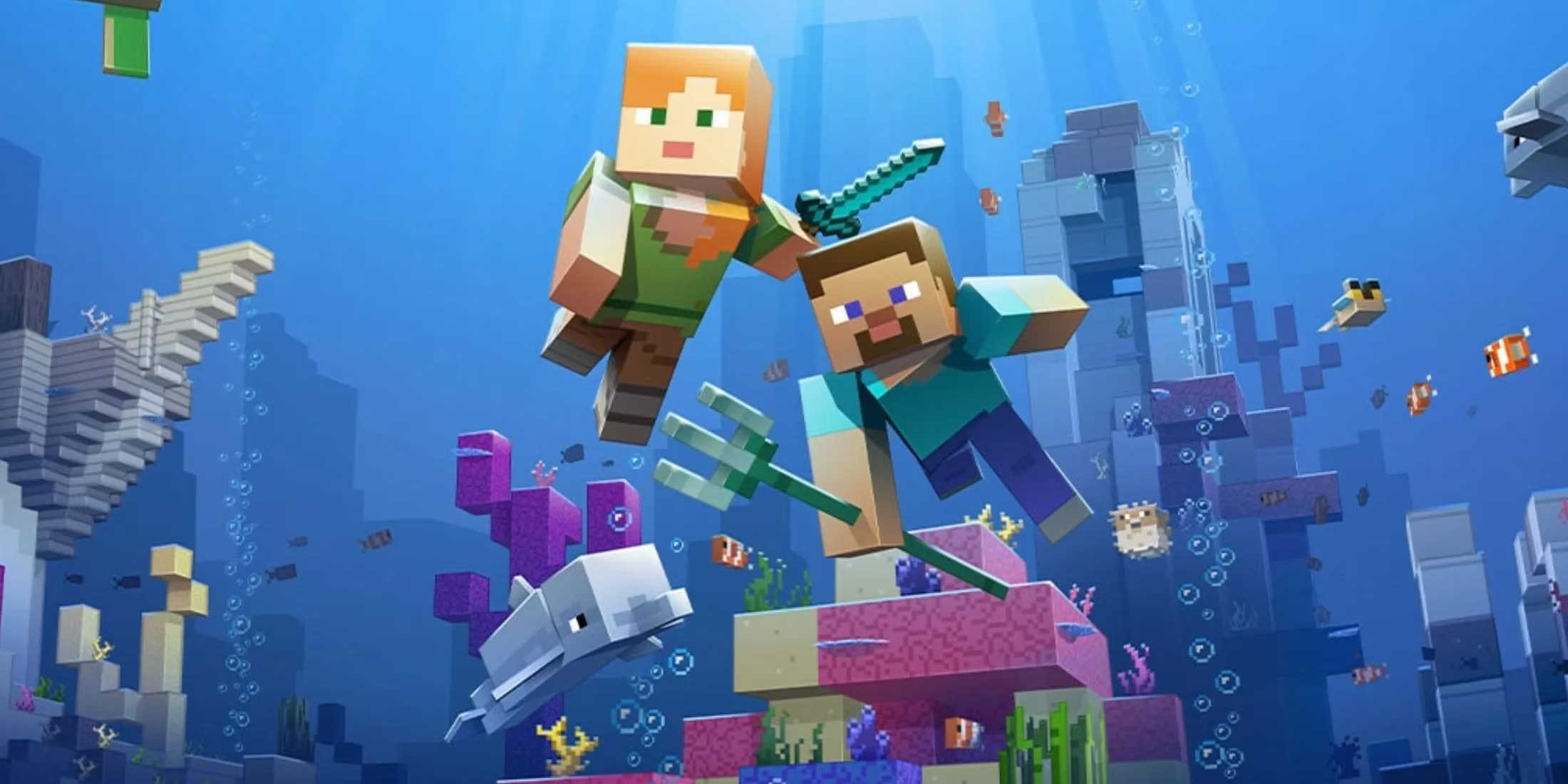
The core issue is deceptively simple yet often overlooked. Dolphins in Minecraft, much like their real-world counterparts, are air-breathing mammals. This isn't just a cosmetic detail; it's a fundamental part of their survival code. Within the game's logic, a dolphin must surface to breathe periodically. If submerged for approximately four minutes without access to air—trapped in an enclosed aquarium, for instance—it will begin to drown. This mechanic is why players find their aquatic exhibits turning into somber memorials. Isn't it ironic that a creature so associated with the ocean can perish within it, in a game where so many other rules are bent? This detail showcases Mojang's attempt to inject a slice of biological realism into the voxel world, even if the consequence is a frustrating limit for aspiring marine architects.
So, what exactly are Minecraft's dolphins? Introduced in the monumental Update Aquatic, these neutral mobs spawn in warm, lukewarm, and deep ocean biomes. They are more than just decorative fauna; they interact with players in meaningful ways:
-
Speed Boost: Swimming near a dolphin grants the player a status effect called "Dolphin's Grace," significantly increasing swimming speed.
-
Trust System: Players can feed dolphins raw cod or salmon. Doing so doesn't "tame" them in the traditional sense, but it does improve their "trust," making them more likely to interact positively and lead players to nearby shipwrecks or underwater ruins.
These features make them a fantastic element for exploration and companionship. Yet, this very intelligence and utility make their vulnerability in enclosed spaces all the more poignant for players who wish to showcase them.
Given this fatal limitation, how can players who want to include dolphins in their builds keep them alive? The community has brainstormed several solutions, though each comes with caveats.
1. The Biome Balance Act: The most reliable method is to create a habitat that isn't fully enclosed. Fans agree that a balanced biome, offering both ample water and open air spaces, is the ideal simulated habitat. Think of a massive, naturally shaped lagoon open to the sky, rather than a glass box. This allows dolphins to pathfind to the surface and breathe.
2. The Potion Perk (For Players, Not Pets): A player under the Water Breathing status effect is immune to drowning. Could this help the dolphins? Indirectly, yes. A player with this effect can stay submerged to build a more suitable, open-air habitat. However, the potion effect itself cannot be applied to the dolphins. There is no way to bestow upon them the magical ability to breathe underwater indefinitely.
3. The Technical Pitfall: Redditors have pointed out a more technical and tragic cause of dolphin death: rendering distance. If a player builds an aquarium and then moves far enough away for the chunks to unload, the game's simulation for that area pauses. When the player returns and the chunks reload, the game might miscalculate the time the dolphin has been submerged, causing it to instantly drown upon reload. This is a bug that the community has long hoped Mojang would address, calling for more robust and "bug-free" animal AI.
| Solution Attempt | How It Works | Major Limitation |
|---|---|---|
| Enclosed Aquarium | Aesthetic containment. | Dolphins drown without air access. |
| Open-Air Lagoon | Provides natural air pockets. | Not a traditional "tank" aesthetic. |
| Water Breathing Potions | Allows player extended underwater build time. | Cannot be applied to dolphins. |
| Hope for a Fix | Community asks Mojang for updated dolphin AI. | Dependent on a future game update. |
This discussion inevitably leads to a look at Mojang's history with aquatic life. The Update Aquatic was a landmark addition that revitalized the oceans of Minecraft. It added coral reefs, shipwrecks, turtles, and many fish species—most of which can happily live in an aquarium. Dolphins were included as a flagship, interactive mob. Their need for air is a deliberate design choice, a small thread of realism woven into their code. Yet, as the game approaches its 15th anniversary and continues to be played by hundreds of millions monthly, players naturally hope for deeper simulation. The fandom's desire isn't just for a "fix," but for an enhancement—perhaps a future update could introduce a way to create functional aquatic sanctuaries or more resilient dolphin behaviors.
When building underwater, players have tools to help themselves, which only highlights the dolphins' plight. The Aqua Affinity enchantment for helmets is essential. It allows for normal mining speed underwater, making large-scale aquatic projects feasible. Combined with Respiration enchantments and Water Breathing potions, a player can become a master underwater architect. But these tools are exclusively for the player character. This disparity underscores a fundamental aspect of the game: while the environment can be shaped infinitely, the core behaviors of certain mobs remain fixed, preserving specific challenges and realities. We can reshape the world, but can we—and should we—reshape the nature of its inhabitants?
In the end, the plight of the Minecraft dolphin in an aquarium is a small but powerful reminder of the game's enduring design philosophy. It blends open-ended creativity with specific, sometimes stubborn, rules that give the world its unique texture and challenge. The dolphin's need for air is a constraint, but it's a constraint born from a recognizable reality. It sparks conversation, problem-solving, and community feedback. As Minecraft sails forward in 2026, still standing tall as one of the best-selling and most-played games in history, it is this interplay between boundless creation and defined simulation that keeps its world feeling alive, surprising, and worthy of endless exploration. Perhaps one day, a new update will bring mechanics that allow for truly thriving dolphin habitats. Until then, builders will continue to craft their magnificent open-air lagoons, learning to appreciate these intelligent mobs not as captives in a tank, but as free-spirited companions in their vast, blocky seas. 🐬
Comments