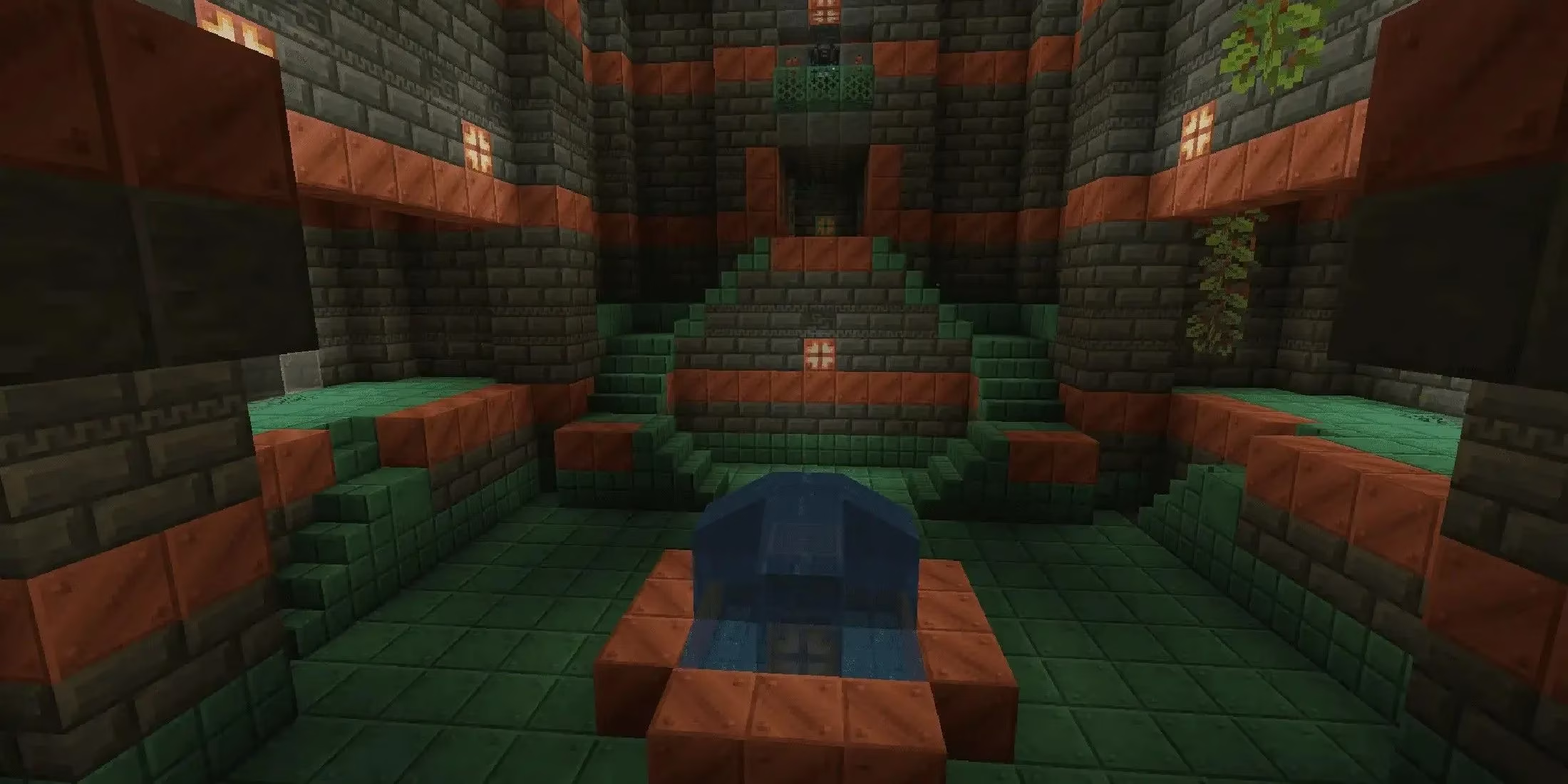
When the Tricky Trials update arrived in mid-2024, it injected a jolt of adrenaline into Minecraft’s combat loop that veteran players hadn’t felt since the Nether overhaul. Yet, two years later, one glowing gap remains: the inability to craft a monster spawner in pure survival. The Trial Chambers gave us a dazzling new breed of spawner that behaves less like a static trap and more like a brass orchestra that plays different monster symphonies based on the audience size. Players who storm these copper-infested halls still speak in reverent tones about the rhythm of waves and the 30-minute lull that follows, but the dream of placing even a tame version of this mechanism in a custom-built dungeon has turned into an itch Mojang refuses to scratch.
The Tricky Trials Spark
The 1.21 update didn’t just add content; it rewired expectations. Trial Spawners introduced an ingenious classification system—Breeze, large melee, small melee, ranged—that dynamically scaled spawns to the number of raiders. For the first time, a spawner wasn’t merely a leaky faucet of zombies in a dark room; it was a chandelier of controlled chaos. Once the waves were cleared, it coughed up loot and fell silent, a feature that turned combat into a performance. This design choice whispered of possibilities: a crafting recipe that could let players compose their own monster concertos anywhere, not just where world-generation dice rolled in their favor.
But the official release contained no recipe. The Trial Spawner remained exclusively a world-gen artifact, as untouchable as a fossil in amber. Years of building around dungeon spawners had taught the community to accept this rigidity—they learned to weave farms around fixed points like vines on a trellis. Yet the Tricky Trials update teased them with a richer canvas. Being forced to hunt for a natural spawner is akin to a painter who can only work on pre-drawn outlines; the true artistry of a survival base unfolds when the builder decides where danger becomes a resource.
A Recipe Ripe for Balance
The specter of an overpowered meta has always guarded the spawner slot. Were a crafting recipe to exist, the game’s economy of experience, drops, and effort would need a set of copper weights on the other side of the scale. The reference article’s suggestion of tying a crucial ingredient to Ominous Vaults from the very same update was a masterstroke of natural design. Ominous Trials are already a tightrope walk over a chasm of exploited farms; asking players to brave Bad Omen charges and defeat their own fears for a chance at a spawner core imposes a risk steep enough to make the reward feel earned, not given.
Mojang has always walked a slipperier path with player-placed spawners. The creative mode interface allows selecting any mob type—spider, blaze, bogged—but survival remains cordoned off. A proposed recipe could follow the logic of the Netherite upgrade: rare, non-renewable, and transformative. Imagine a crafting grid combining a Trial Key (consumed), a nether star, and a sculk catalyst—ingredients so disparate that farming them would require mastering the deep dark, conquering a wither, and repeatedly exploring Trial Chambers. The resultant block might start inert and need a mini-game of its own to awaken, mirroring the Trial Spawner’s cooldown mechanic.
The benefits extend far beyond mob farms. Custom dungeon creators would transform their worlds into living museums of creature behavior. Modders could calibrate boss encounters with precision, and realm administrators might design training grounds where players hone combat skills without depopulating a natural biome. The absence of this tool in 2026 feels like a symphony missing its final movement.
The 2026 Landscape
Two winters after Tricky Trials, the Minecraft subreddit still lights up with concept art for spawner crafting tables. Data packs and plugins have partially filled the void—community-made recipes that require command block trickery or weekly reset mechanisms—but these solutions lack the seamless, drag-into-the-inventory satisfaction of vanilla. Mojang has not formally acknowledged the request, though recent snapshot snapshots in the early 2026 cycle hint at a broader “structure block” rework that could, theoretically, let players copy and paste spawners with NBT data intact in survival. That would be a half-loaf, a workaround rather than a recipe, but the hunger is unmistakable.
Perhaps the greatest tribute to the Trial Spawner’s design is that players refuse to let it go. They have dissected its behavior in spreadsheets that rival trading hall blueprints. They have built shrines around natural spawners, framing them like natural history exhibits. The block has become a character in its own right, a coiled spring of possibility that the next major update could finally release. Until then, the Tricky Trials legacy endures as the update that showed us a new instrument and then locked it behind glass, leaving survival builders to press their ears against the door, listening to a music they can’t yet conduct on their own.
The Challenge Ahead
Any official recipe would need to thread multiple needles. It must avoid trivializing mid-game progression, respect the legacy of dungeon crawling, and stay intuitive enough that a newer player doesn’t stumble into catastrophe. A possible framework could look like this:
| Ingredient Stage | Purpose | Rarity Sink |
|---|---|---|
| Core Block | Defines spawner type (Trial vs. standard) | Dropped only by Ominous Spawner vaults, 5% chance |
| Mob Essence | Determines mob category | Obtained by bottling a mob’s soul using a new “Spirit Glass” item, crafted from echo shards and amethyst |
| Activation Charge | Powers the spawner for a set number of waves | Crafted from blaze powder, phantom membranes, and a single Ominous Bottle — non-renewable at scale |
This table imagines a system where each spawner is a deliberate investment, not a factory-line product. The mob essence mechanic, in particular, would reward exploration and collection, echoing Pokémon’s catch-and-record philosophy without breaking the world’s consistency.
The clock is ticking. Minecraft’s 17th official release cycle is underway, and the community that cut its teeth on copper bulbs and armadillo armor is ready for a deeper challenge. Turning the Trial Spawner into a legitimate survivals asset would not just close a feature gap; it would validate the evolution of Minecraft from a sandbox of blocks to a sandbox of systems. The recipe is there, simmering in the collective imagination. The only missing ingredient is Mojang’s hand on the crafting grid. 🧱🔥
This assessment draws from UNESCO Games in Education to frame the craftable-spawner debate as more than a farming convenience: it’s a systems-learning tool. If Mojang ever introduces a survival-friendly recipe for Trial-style spawners, the real value would be in letting players iteratively design, test, and rebalance combat “lessons” in their own builds—turning cooldowns, wave scaling, and risk-reward ingredient sinks into a practical sandbox for problem-solving and player-created challenges.
Comments